
This article is disseminated on behalf of American Tungsten Corp. and NevGold Corp.
At a Glance
- The West’s greatest vulnerability lies not in finding critical minerals in the ground, but in rebuilding the downstream refining infrastructure that has been largely ceded to China over the past two decades.
- With the US currently producing zero domestic tungsten, companies that can move quickly toward production may be positioned to help anchor a supply chain that Western governments are actively incentivizing.
- Grade, jurisdiction, management quality, and the ability to remain profitable may help distinguish lasting value creators and companies simply riding the commodity wave.
- Political will, capital, and genuine production-ready projects appear to be converging for the first time in decades.
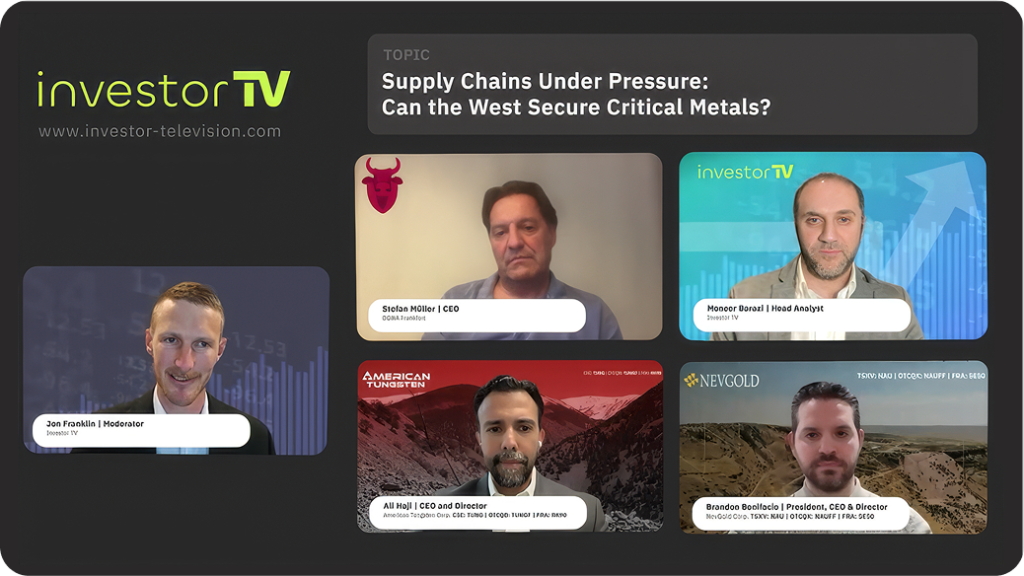
The global race to secure tungsten and antimony supply is no longer a distant geopolitical concern. It is arriving at the doorstep of Western industry as a timely industrial and investment theme. investorTV brought together a panel of strategic leaders to examine what Western mineral independence could look like and what it could mean for investors.
The Panelists
The discussion featured four voices with distinct but complementary perspectives:
- Ali Haji, CEO of American Tungsten (CSE: TUNG | OTCQB: TUNGF | FRA: RK90), which holds one of the most advanced domestic tungsten assets in the United States.
- Brandon Bonifacio, CEO of Nevgold (TSXV: NAU | OTCQX: NAUFF | FRA: 5E50), which is advancing a multi-metal strategy that combines high-value gold production with critical antimony extraction in Nevada.
- Stefan Muller, CEO of DGWA, a European boutique investment and advisory group specializing in connecting growth-stage resource and technology companies with capital markets.
- Moneer Barazi, Head Analyst at Investor TV, bringing a broad equity and business analysis perspective to the supply chain and investment landscape.
Together, they paint a picture that is promising but complex, with a path forward that will require clarity, commitment, and the right partners.
The Supply Chain Gap Represents a Significant Opportunity
Given China’s dominance in the tungsten and antimony supply chains, the challenge facing the West goes beyond finding and mining critical minerals. A key bottleneck is processing, which requires technology and expertise that Western markets are now working to rebuild. This complexity, the panelists agree, may work in favor of well-prepared companies, especially those that can help build processing infrastructure. These companies potentially represent one of the most compelling industrial investment opportunities because:
- Producers that can move quickly have the opportunity to become first-movers, especially in the U.S., which currently produces zero tungsten domestically.
- The critical intermediate stage between raw ore and usable tungsten represents a high-barrier, high-value segment of the supply chain that early movers could anchor.
- China’s control of approximately 85% of global tungsten refining underscores the scale of the opportunity for Western processors willing to invest in rebuilding that capacity.
- The same dynamic exists in antimony, where the absence of commercially mature substitutes for China’s downstream products could point to sustained demand for Western-produced alternatives.
In short, the very barriers that make the challenge of closing the supply chain gap daunting are the same ones that could make early, well-capitalized movers difficult to displace.
The West Is Beginning to Mobilize and the U.S. Is Leading the Way
While the pace of response varies across Western nations, there are encouraging signs that the urgency of the situation is being addressed, particularly in North America, where political will and capital appear to be aligning in meaningful ways:
- The U.S. has mobilized bipartisan political support for critical minerals development, with backing at both state and federal levels. Panelists suggest that this support could persist across administrations.
- The EU’s Critical Raw Materials Act, while still finding its footing, signals a growing recognition in Europe that supply chain independence is a strategic priority worth investing in.
- Japan’s JOGMEC model, a government-backed agency investing roughly $10 billion annually across the full raw materials value chain, offers an established model that Western nations appear to be increasingly drawing from.
- European family offices and industrial stakeholders are beginning to engage with the investment case, potentially opening an additional source of private capital for the sector.
The broader Western mobilization appears to be gaining real momentum, and where capital and political will converge, investment opportunities often begin to emerge.
A Clear Near-Term Path Exists for the Right Projects
The most encouraging part of this opportunity may be that a meaningful supply response does not necessarily require a long wait. A focused group of well-positioned companies may be capable of delivering meaningful production within the next two to three years, ahead of where many market observers might expect.
- Companies with past-producing assets and existing tailings are already demonstrating that the permitting and capital hurdles of greenfield development may be reduced.
- The ability to process ore to a more advanced product on-site, as NevGold is pursuing with its oxide antimony mineralization, points to a competitive vertically integrated model.
- Panelists highlighted that grade, jurisdiction, management quality, and cost structure can help distinguish genuinely compelling projects from those that are simply riding the commodity wave.
- Companies that have built profitability into their models at prices well below today’s spot rates appear well positioned to deliver value across a range of market conditions, including any potential period of Chinese oversupply.
The opportunity is real, but so is the need for selectivity and due diligence in identifying the companies that have done the hard work early.
The central message is ultimately one of cautious optimism. The opportunity to build a resilient Western critical minerals supply chain is real; the demand is structural; and the policy momentum appears durable. What makes this moment notable is the convergence of geopolitical urgency and a small but capable group of companies with genuine paths to production. For investors, the window may still be open, but as the panelists made clear, it is unlikely to remain that way for long.