
This article is disseminated on behalf of Arianne Phosphate Inc., Lion Rock Resources Corp., and Vortex Metals Inc.
At a Glance
- The United States needs to develop a secure domestic battery metals pipeline as the energy transition shifts into a new phase, moving past EV enthusiasm and toward the integrated battery supply chain.
- Battery energy storage system demand is expected to increase, while the supply of copper, phosphate, lithium, and other critical metals will remain constrained without support from Western battery metal projects.
- Exploration alone is not the full picture; mineral refining and development are equally critical to building a domestic value chain and bringing batteries closer to the end consumer.
Buzzwords have littered the landscape surrounding the battery metal industry, often focused on the “next big breakthrough.” However, the deeper reality emerging in the industry is less dramatic and more structural.
The next frontier is not a single invention. It is the development of integrated domestic supply chains as a long-term opportunity.
Panel Overview
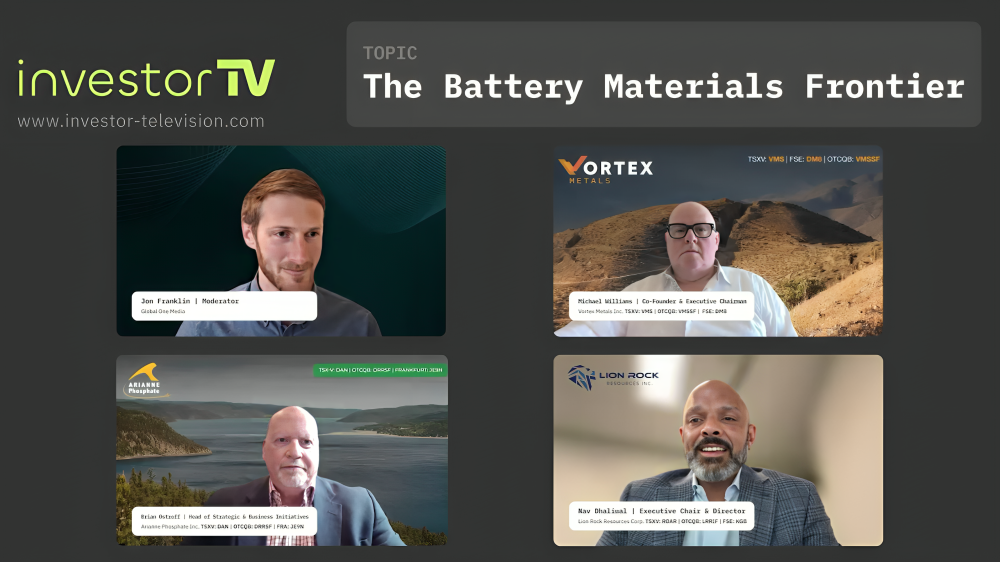
On April 14, 2026, investorTV hosted a webinar titled The Battery Materials Frontier, featuring keynote speakers with deep expertise in battery metals and insights into the potential contributions of their respective company’s projects. The guest speakers were:
- Brian Ostroff, Head of Strategic & Business Initiatives, Arianne Phosphate Inc. (TSXV: DAN | OTCQB: DRRSF | FRA: JE9N)
- Nav Dhaliwal, Executive Chair & Director, Lion Rock Resources Corp. (TSXV: ROAR | OTCQB: LRRIF | FSE: KGB)
- Michael Williams, Co-Founder & Executive Chairman, Vortex Metals Inc. (TSXV: VMS | OTCQB: VMSSF | FSE: DM8)
Supply Chains: The Missing Link to Western Mineral Independence
Battery metals are no longer just industrial products; they are geopolitical assets. Lithium, nickel, cobalt, and graphite form the backbone of modern energy storage, and their supply chains are highly concentrated geographically.
“So the LFP battery [market] today, 97% of them come from China,” explains Brian Ostroff, Head of Strategic & Business Initiatives at Arianne Phosphate Inc., highlighting the significant hurdle for Western mineral independence.
This creates a structural vulnerability: the future of batteries is now tightly coupled to which countries can mine, refine, and manage logistics.
“[The U.S.] needs a sovereign source, and they want it preferably in the Western Hemisphere. So I think there’s a tremendous opportunity right now for the battery metal people to [focus] in the United States or Canada.”
Michael Williams, Co-Founder & Executive Chairman, Vortex Metals Inc.
As demand for electric vehicles and grid storage expands, the mineral exploration and development space has swiftly turned into a strategic competition between nations, not just companies.
We Already Have Access to What We Need
For the West, high-potential projects already exist, checking boxes for metallurgy, infrastructure, and related factors. This is turning what was once a possibility into real potential. Michael Williams, Co-Founder and Executive Chairman of Vortex Metals Inc., emphasizes the scale of this shift: “The energy transition is just taking so [many] metals. Critical metals are obviously key going forward.”
Critical minerals such as lithium, phosphate, and copper are:
- geographically concentrated
- politically sensitive
- price-volatile
Given current market conditions, the mineral exploration and development sector is experiencing strong growth. The critical question is how the West is positioning itself in response.
Development Isn’t A Suggestion; It’s Necessary
Exploration is only one part of the solution. To complete the domestic loop, refining and development processes must also be stabilized.
“[It is] very important that we can discover all these commodities; it’s about the refining of these product[s] as well. And we see that the U.S. is starting to shape up in that sense.”
Nav Dhaliwal, Executive Chair & Director, Lion Rock Resources Corp.
We are entering a new era where energy itself is becoming a core commodity. Building a domestic value chain has long-term implications, as batteries are essential for powering data centers, grid systems, and electric vehicles.
By strengthening Western mineral projects with viable development pathways, the West can secure the feedstock needed to build its battery supply chain while reducing geopolitical risk.
Key Takeaways
- Critical mineral supply chains are geographically concentrated and vulnerable to price swings and geopolitical risk. Western supply chains are developing but will need continued support in order to flourish.
- The long-term goal is an integrated domestic battery materials loop. This means extracting minerals domestically or from trusted partners, refining them locally, and producing battery-grade materials closer to end use.
Securing the Future of Battery Metals Supply Chains
Batteries are foundational to EVs, grid storage, data centers, and modern digital infrastructure. Their future will not be determined by a single breakthrough, but by who can secure and scale the materials and supply chains behind them.
The West still has a long way to go in developing a domestic supply chain, but it is on the right path. The question now is whether that momentum can be sustained.