
This article is disseminated on behalf of American Tungsten Corp., North American Niobium and Critical Minerals Corp., EQ Resources Ltd, and Hallgarten + Company.
At a Glance
- Amid geopolitical shifts, the West aims to reduce reliance on Chinese-controlled critical metals supply chains.
- Small-scale, high-grade mining projects can be developed faster, but government red tape continues to slow progress.
- While defense drives mineral demand in the short term, emerging markets will likely support long-term growth.
Introduction
Critical metals are becoming more valuable amid recent geopolitical shifts, as demand rises drastically despite ongoing supply crunches. As industries from defense to tech grow increasingly metal-intensive, the structural vulnerabilities of Western supply chains have evolved from a logistical concern into a national security issue.
At the core of these concerns is China, which currently controls huge portions of the world’s critical metals markets. For instance, China holds 85% of global tungsten supply, a metal widely used in military applications, while also implementing export restrictions on the mineral. Therefore, the global supply chain faces a harsh reality: in a conflict scenario, domestic production cannot be created out of thin air.
Western mining companies have started rising up to the occasion by exploring new sources for critical metals, while nations reassess where their strategic metals come from, how they’re developed, and who ultimately controls them.
Panel Overview
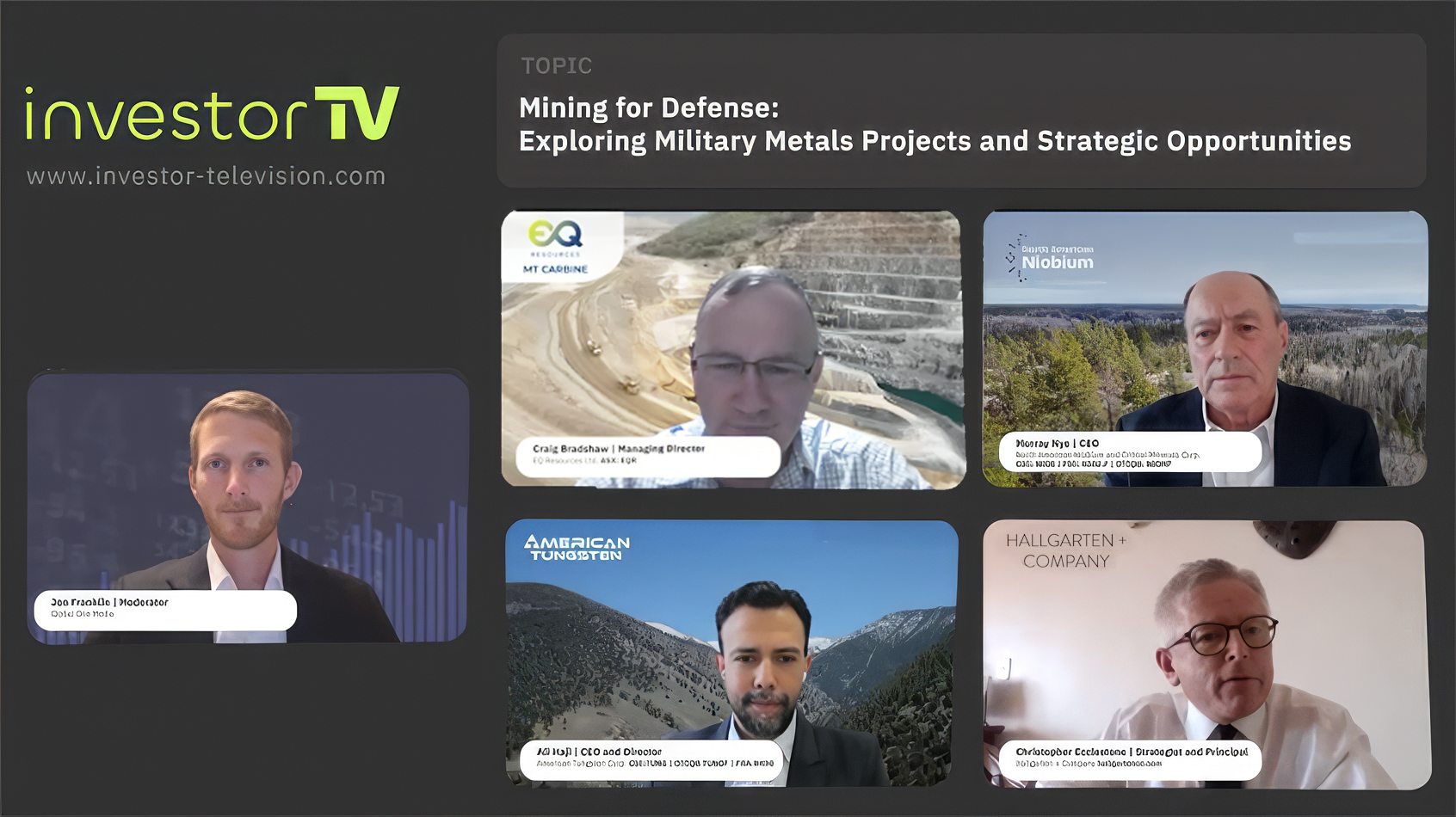
Against this backdrop, Investor TV convened a panel discussion titled “Mining for Defense: Exploring Military Metals Projects & Strategic Opportunities” in January. The panel provided multiple perspectives on the exploration of critical minerals such as tungsten, niobium, and rare earth elements, while also discussing regulations, international markets, and growth prospects.
This discussion features experts addressing the urgent need for mineral independence: Ali Haji, the CEO of American Tungsten Corp.; Murray Nye, the CEO of North American Niobium and Critical Minerals Corp.; Craig Bradshaw, the Managing Director of EQ Resources Ltd.; and Christopher Ecclestone, Strategist and Principal at Hallgarten + Company, a research and advisory firm focused on the natural resources sector.
The panel represents companies at the forefront of critical mineral exploration. American Tungsten aims to reopen the IMA Mine Project in Idaho as a domestic source of tungsten, molybdenum, and silver. North American Niobium is focused on exploring niobium in Quebec, while EQ Resources is advancing tungsten projects in Spain and Australia.
Pathways to Decoupling from Critical Mineral Dependence on China
One major theme that emerged during the panel discussion is the ongoing challenge of addressing the world’s heavy dependence on China for critical metals.
Emphasizing the issues related to this level of reliance, Ecclestone noted that tungsten was unprofitable partly due to artificial price suppression from China. In the case of niobium, another critical mineral heavily used in the military, “the Chinese have a lock on that [niobium] mine in Brazil and they do all the processing,” Nye concurred.
Compounding this dilemma, China also excels in processing capacity. “China played the long game with respect to ensuring that they have not only the resources, but also the reagents and the processing capacity to produce the goods and services that we now demand for the rest of the world,” said Haji.
This outsized role of China in the critical metals space is changing the way mining exploration companies are thinking about competition. “Effectively, the competition is the Chinese government,” according to Bradshaw. “To overcome that and overcome aspects of that, that’s where government support is needed to make sure that it’s a level playing field.”
The Shift Toward Small and Nimble Project Development
To adjust for current geopolitical realities, the panelists pointed out that the mining exploration industry is moving toward smaller, more agile projects that avoid the capital-intensive traps of mega-sized mining projects and their 10- to 15-year development timelines.
By focusing on brownfield restarts or smaller, high-grade deposits, developers can reach commercial production significantly faster, providing the immediate critical mineral supply required for defense and high-tech manufacturing.
Whether junior mining exploration companies are getting adequate investor support to advance their projects is up for debate. American Tungsten’s Haji acknowledged that the fundraising conditions for companies like his have improved compared to two years ago, with government-driven demand serving as a tailwind.
However, Ecclestone expressed confusion about governments’ tendencies to back projects from large-cap companies when they don’t need the extra funding. Bradshaw agrees, adding, “The challenge is if you are backing big projects, it’s a case of are you putting all your eggs in one basket as opposed to multiple smaller projects.”
Governments Want More Minerals, But Permit Woes Persist
As Haji pointed out, government-driven interest in bringing critical mineral production onshore has helped spur increased investor interest in the domestic mining industry. Minerals like niobium are becoming “very critical to the defense industry with the different types of alloys that it produces” for military and industrial uses, as North American Niobium’s CEO Nye points out.
The American Tungsten CEO did have a caveat regarding government support: “You know, the only thing that’s standing in the way is now some of the permitting.”
EQ Resources’ Bradshaw provided a more blunt take: “If governments are serious about solving the supply-side issues across the variety of critical minerals, then a lot of work needs to be done on the government side to remove red tape to be able to have projects or mines and operations that have previously been in operation come back into operation much faster.”
Hallgarten’s Ecclestone also noted that provincial and national regulators “are still dragging their feet” on the subject of fast-tracking mining exploration projects, adding that “they’re saying this is something we must have, and yet they’re still assessing the permitting as if it’s some sort of elective mining activity.”

Growth Story: Defense Spending Now, Emerging Markets Soon
Despite ongoing geopolitical and regulatory concerns in critical mineral mining, the panel expressed optimism in the industry’s growth trajectory, identifying two main catalysts: defense and emerging markets.
Defense spending is not about to plateau, according to both Ecclestone and Haji, with the former having a more bullish stance: “It’s on a trajectory upwards and we’re not even near where it’s going to go.” He also noted that there had been a lot of focus on chips and sophisticated widgets needed for next-generation defense tech, raising prices for required materials.
While Haji concurs that governments will not pull back on defense spending in the near term, he thinks there’s a more crucial and long-lasting growth factor for the industry: emerging markets.
“The elements that we’re speaking about today are used in various capacities: automotive, wind power, nuclear power, microchips. Look at where the GDP is growing the fastest, it’s the emerging markets. Demand is going to start to come from these emerging markets and continue to support the price increments,” he said.
Key Takeaways
- Supply Chain Fragility: Western markets remain dangerously over-reliant on Chinese-controlled supply chains for critical metals.
- Small-Scale Agility: The path to production independence relies on nimble, small-scale, high-grade projects rather than multi-billion-dollar “megamine” developments.
- Permitting is the Primary Hurdle: While government rhetoric supports domestic mineral independence, the speed of actual permitting remains the single biggest bottleneck to meeting defense requirements.
- Defense, Emerging Markets as Catalysts: Defense and geopolitics may drive mineral demand up in the short term, but emerging markets unlock long-term growth.
The Road Ahead
The race for military-relevant metals is not a short-term trend but a long-term strategic necessity driven by emerging market growth and the imperative of defense sovereignty. As defense spending continues to climb, the projects most likely to thrive will be those that manage to balance operational discipline and fast execution with the ability to navigate complex regulatory landscapes.
For investors, the focus remains on companies that move beyond rhetoric and prove they can reliably deliver finished products to a global market with heightened demand for critical minerals amid geopolitical shifts and supply chain pressures.